Diagnostics
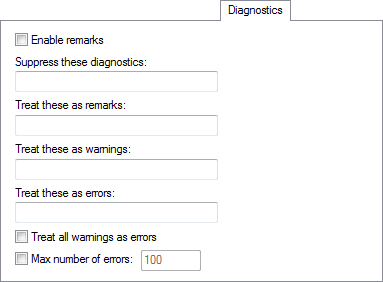
The Diagnostics options determine how diagnostic messages are classified and displayed. Use the diagnostics options to override the default classification of the specified diagnostic messages.
Note
The diagnostic messages cannot be suppressed for fatal errors, and fatal errors cannot be reclassified.
Enable remarks
Enables the generation of remarks. By default, remarks are not issued.
The least severe diagnostic messages are called remarks. A remark indicates a source code construct that might cause strange behavior in the generated code.
Suppress these diagnostics
Suppresses the output of diagnostic messages for the tags that you specify.
For example, to suppress the warnings Xx117 and Xx177, type:
Xx117,Xx177
Treat these as remarks
Classifies diagnostic messages as remarks. A remark is the least severe type of diagnostic message. It indicates a source code construct that might cause strange behavior in the generated code.
For example, to classify the warning Xx177 as a remark, type:
Xx177Treat these as warnings
Classifies diagnostic messages as warnings. A warning indicates an error or omission that is of concern, but which will not cause the assembler to stop before assembly is completed.
For example, to classify the remark As098 as a warning, type:
As098Treat these as errors
Classifies diagnostic messages as errors. An error indicates a violation of the language rules, of such severity that object code will not be generated, and the exit code will be non-zero.
For example, to classify the warning Xx117 as an error, type:
Xx117Treat all warnings as errors
Classifies all warnings as errors. If the assembler encounters an error, object code is not generated.
Max number of errors
Specify the maximum number of errors. This means that you can increase or decrease the number of reported errors, for example, to see more errors in a single assembly. By default, the maximum number of errors reported by the assembler is 100.