List
The List options make the assembler generate a list file and determine its contents.
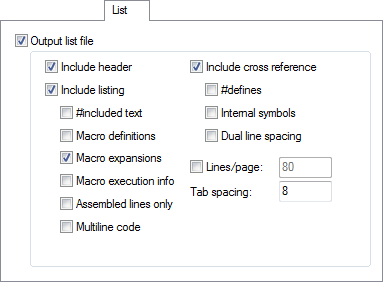
Output list file
Makes the assembler generate a list file and send it to the file sourcename.lst. By default, the assembler does not generate a list file.
If you want to save the list file in another directory than the default directory for list files, use the Output Directories option in the General Options category, see Output. You can open the output files directly from the Output folder which is available in the Workspace window.
Include header
Includes the header. The header of the assembler list file contains information about the product version, date and time of assembly, and the command line equivalents of the assembler options that were used.
Include listing
Selects which type of information to include in the list file. Choose from:
- #included text
Includes
#includefiles in the list file.
- Macro definitions
Includes macro definitions in the list file.
- Macro expansions
Excludes macro expansions from the list file.
- Macro execution info
Prints macro execution information on every call of a macro.
- Assembled lines only
Excludes lines in false conditional assembler sections from the list file.
- Multiline code
Lists the code generated by directives on several lines if necessary.
Include cross reference
Includes a cross-reference table at the end of the list file. Choose from:
- #define
Includes preprocessor #defines.
- Internal symbols
Includes all symbols, user-defined as well as assembler-internal.
- Dual line spacing
Uses dual-line spacing.
Lines/page
Specify the number of lines per page, within the range 10 to 150. The default number of lines per page is 80 for the assembler list file.
Tab spacing
Specify the number of character positions per tab stop, within the range 2 to 9. By default, the assembler sets eight character positions per tab stop.